Career Insights
What Is a Good ATS Score? What It Measures and How to Improve It
There is no universal ATS passing score the number depends entirely on the tool that produced it. Here is what ATS scores actually measure, why tools give different results, and how to improve what actually matters.
By Kavya · 25 Nov 2026
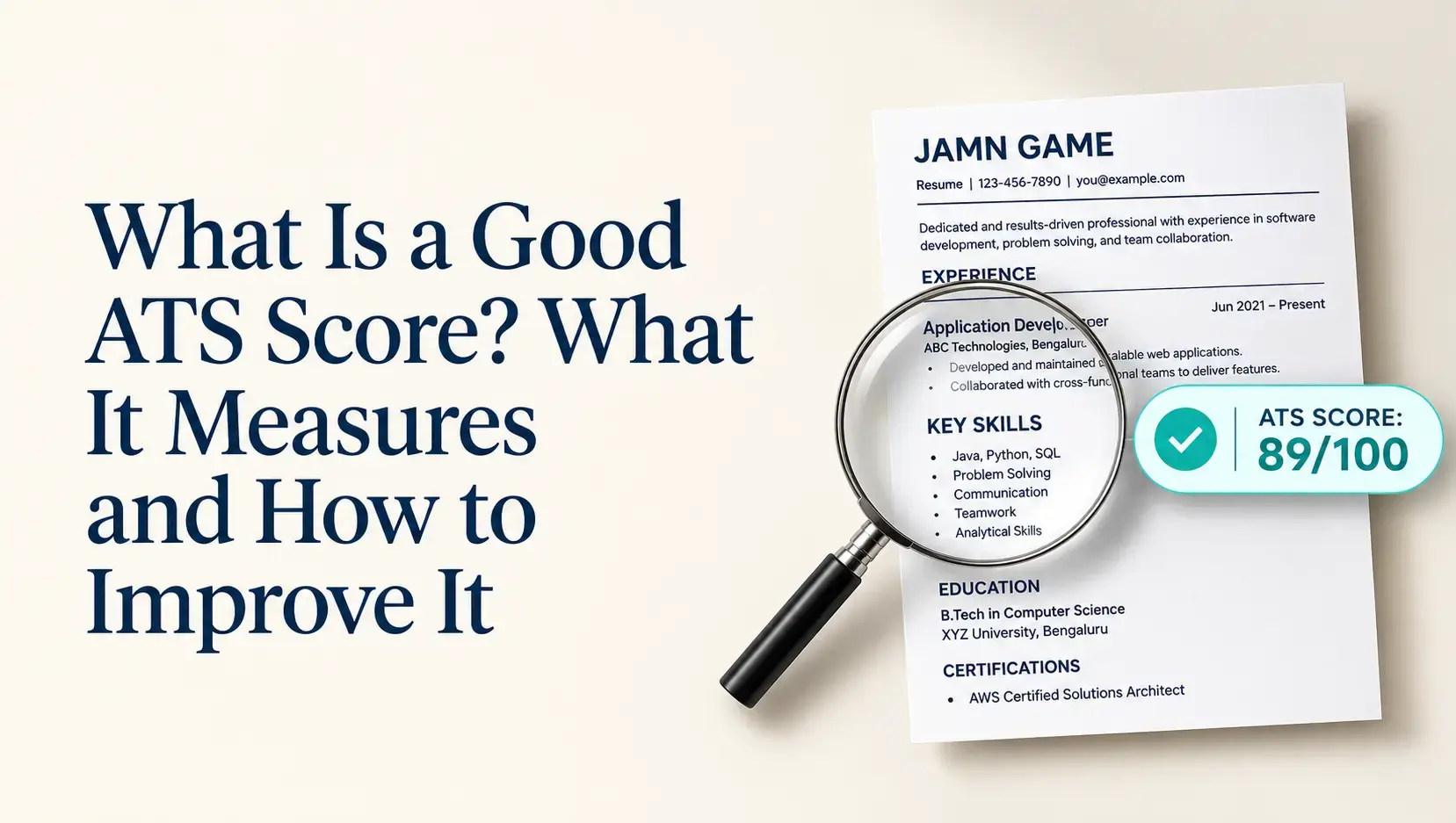
Quick Answer: There is no universal “good” ATS score that applies to every employer, applicant tracking system, or resume scanner. Some third-party resume checkers recommend a job-description match rate of around 75–80% within their own tools, but this is not an official employer screening threshold. A high score does not guarantee an interview. Focus on whether your resume is relevant to the role, easy for software and recruiters to read, and supported by genuine evidence of your skills and experience.
You upload your resume to a scanner, paste a job description, and receive a score of 58%, 76%, or 91%. Naturally, you want to know whether that number is good enough.
But what does the score actually mean? Does an 85% score mean your resume will pass an employer’s ATS? Should you keep editing until you reach 90%? And why can the same resume receive different scores from different tools?
The answer depends on what the tool measures.
At ProfileNext Career Services, we believe resume optimization should focus on more than a number. Understanding the difference between an ATS, a resume scanner, and actual job requirements helps you make better decisions about your applications.
In India’s job market, where candidates apply through Naukri, LinkedIn, and company career portals, ATS scores from third-party tools are widely misunderstood. They often lead to unnecessary keyword stuffing, which can hurt a resume more than it helps.
Key Takeaways
There is no universal ATS passing score.
A 75–80% match rate can be a useful target in some third-party scanners, but it is not an employer rule.
ATS scores measure tool-specific factors such as keyword match, formatting, and section completeness.
A high score does not guarantee an interview.
Prioritize relevance, accurate experience, clean formatting, and clear evidence.
For a full guide on why ATS rejects resumes and how to fix the most common issues, see our ATS resume guide.
What Is a Good ATS Score for a Resume?
A good ATS score is one that helps you identify and resolve meaningful gaps in your resume for a specific job. There is no single passing score that guarantees your resume will be shortlisted.
Some third-party scanners provide a percentage based on how closely your resume matches a particular job description. Others evaluate resume structure, writing quality, keyword coverage, or a combination of these factors.
For example, Jobscan has published guidance recommending a match rate of at least 75% for its own tool. This figure represents Jobscan’s guidance for its own match rate—not a universal rule followed by employers.
Use this principle: Treat your ATS score as a diagnostic result, not a pass-or-fail decision.
A lower score can help you discover missing job-related keywords or unclear experience descriptions. A higher score can indicate strong textual alignment, but you must still verify that the resume accurately represents your qualifications.
What Does an ATS Score Actually Measure?
An ATS score is not one standardized measurement. Its meaning depends on the resume checker or scoring method producing it.
Here are the most common areas a resume scanner may evaluate.
1. Keyword Match With the Job Description
Some resume scanners compare the words and phrases in your resume against the requirements listed in a job description.
These may include:
Technical skills and software tools
Job titles and role-specific terminology
Industry knowledge and functional skills
Required certifications or qualifications
Relevant soft skills and responsibilities
Consider a Data Analyst job description that mentions SQL, Excel, Power BI, dashboard development, and data validation.
If your resume includes SQL and Excel but does not mention your relevant Power BI experience, a scanner may identify a keyword gap.
However, the correct response is not to add Power BI simply to increase the score. Add it only if you genuinely have that skill, and demonstrate how you used it wherever possible.
2. Skills and Experience Alignment
Keyword presence alone does not establish that you meet a job’s requirements.
A useful resume review considers whether your experience supports the skills and responsibilities listed in the vacancy.
Weak resume bullet:
Knowledge of SQL and reporting tools.
Stronger resume bullet, if accurate:
Used SQL queries to extract and validate data and supported recurring business reporting in Excel.
The second version provides context for the skill. It explains how the candidate applied the knowledge rather than merely listing it.
A scanner may not fully evaluate the strength of the evidence behind every statement. That is why reviewing your actual experience is essential.
3. Resume Structure and Readability
Some resume checkers also flag formatting issues that could make your information harder for software or people to read.
Examples include:
Contact information placed in difficult-to-read areas
Unusual section headings
Complex tables or multi-column layouts
Skills or contact details embedded in images
Scanned PDFs that contain no selectable text
Inconsistent job titles, employment dates, or section order
Workday’s documentation explains that resume parsing extracts information from a resume into candidate records, and that results can vary according to document formatting and word order. It also recommends avoiding image-based resume styles for better parsing results.
A formatting check and a keyword-match score are different things. Your resume could have clean formatting but limited alignment with a job description, or strong keyword overlap but formatting issues that need attention.
4. Section Completeness and Other Checks
Depending on the tool, a report may also assess whether your resume contains expected sections, such as:
Professional summary
Work experience
Technical or core skills
Education
Certifications and relevant projects
Some scanners evaluate additional factors, including grammar, writing quality, or the clarity of achievement statements.
Do not assume that every tool measures all these factors. Review its explanation of the score before deciding which changes to make.
ATS Score vs. Employer ATS: What’s the Difference?
This is one of the most important distinctions for job seekers.
An online resume checker is a tool that analyses your resume using its own methodology. An employer’s applicant tracking system is recruitment software that can collect applications, organize candidate information, support searches, and manage hiring workflows.
The two are not the same.
According to Greenhouse’s explanation of applicant tracking systems, an ATS helps employers manage candidate information and recruitment activities. Workday’s documentation separately describes how resume parsing populates candidate information into records.
Neither explanation establishes a universal percentage that every employer must use to reject or shortlist resumes.
An employer may use a particular ATS, custom application questions, recruiter searches, qualification requirements, interview scorecards, or other screening steps. These processes vary by organization and role.
This means that:
A 90% score from a third-party scanner does not mean the employer’s ATS has assigned you 90%.
A 65% scanner score does not automatically mean your resume will be rejected.
Two scanners can evaluate the same resume differently because their scoring methods differ.
A high keyword-match score cannot compensate for a missing mandatory qualification.
The goal is not to satisfy an imaginary universal ATS cutoff. It is to make your relevant qualifications clear and easy to evaluate.
How Should You Interpret a 60%, 80%, or 90% ATS Score?
The right interpretation depends on the tool generating the score. The following examples are illustrative, not official scoring bands.
Scanner result | What it might indicate | What to review next |
|---|---|---|
60% | The tool has identified gaps in keyword overlap or another measured area. | Check missing relevant skills, experience descriptions, and formatting warnings. |
80% | The resume has stronger measured alignment within that tool. | Verify important requirements and ensure your experience supports the listed skills. |
90% | The resume has high measured alignment within that tool. | Check for irrelevant repetition, unsupported claims, and missing evidence of achievements. |
These ranges are illustrative, not official scoring bands. Always interpret a score according to the tool that produced it.
A 60% score does not automatically make a resume unsuitable, just as a 90% score does not establish that it is ready to submit.
Imagine that a Business Analyst job requires UAT, requirement gathering, stakeholder communication, and SQL. A candidate’s resume mentions all four terms, but the candidate has not actually performed UAT.
The scanner may recognize the keywords, but the resume does not establish genuine experience with that requirement. Adding more UAT keywords would not resolve the underlying problem.
The correct approach is to represent the candidate’s actual experience accurately and identify any genuine skill gaps.
Why Do Different ATS Checkers Give Different Scores?
Have you ever uploaded the same resume to two tools and received two very different percentages?
That does not necessarily mean one of the tools is broken. Their scoring methods may evaluate different aspects of the document.
1. Different Scoring Methods and Keyword Priorities
One tool may emphasize keyword overlap, while another weighs resume structure, writing quality, job titles, certifications, or specific skills more heavily.
An 80% score in one tool should not be assumed to equal 80% in another.
A raw percentage will not always show how important each individual requirement is to an employer. For example, a mandatory certification may be particularly important for one vacancy, while another role may place greater emphasis on technical tools or relevant years of experience.
2. Different Job Descriptions
A resume is not equally relevant to every position.
A candidate applying for a Junior Data Analyst job may need to emphasize Excel, SQL, reporting, and data validation. The same candidate applying for a Business Analyst position may need to highlight requirement analysis, stakeholder communication, documentation, and UAT—where those skills are supported by their experience.
The score can change because the target requirements have changed.
3. Different Parsing and Formatting Results
A tool may fail to extract some information correctly from a complex or image-based document. Another tool may read the same document differently.
Always inspect the extracted text and formatting warnings where the scanner provides them.
If the resume content is missing, jumbled, or assigned to the wrong section, correct that issue before focusing on the score.
Why Your Resume Should Be ATS-Friendly
An ATS-friendly resume makes it easier for recruitment software to extract relevant information and for recruiters to understand your qualifications.
It does not mean your resume should be written exclusively for software.
A good resume should work for both the technology involved in the application process and the person evaluating your experience.
1. Use a Simple, Readable Format
Start with a clean, single-column layout and conventional section headings, such as:
Professional Summary
Core Skills
Work Experience
Education
Certifications
Projects
Avoid unnecessary graphics, complex tables, elaborate text boxes, and image-based layouts.
For file format, follow the employer’s instructions. On Naukri, a .docx file is generally the most compatible format. On LinkedIn Easy Apply, both PDF and Word files are commonly accepted. Always check the application instructions before submitting.
2. Tailor Your Resume to Each Job Description
Before applying, identify the job’s essential qualifications, tools, responsibilities, and preferred skills.
For example, if a DevOps role asks for Azure, AWS, Docker, Kubernetes, CI/CD, and monitoring, compare those requirements with your actual experience. Highlight the relevant tools and projects you have used instead of listing every technology you have encountered.
The objective is to improve relevance, not to copy the job description.
3. Use Relevant Keywords Naturally
When a job description uses a term that accurately describes your experience, use that terminology where appropriate.
For example, if a role requires User Acceptance Testing (UAT), include the full term or abbreviation when relevant. Describe how you participated in test planning, test execution, defect tracking, or business-user validation, provided those activities reflect your actual work.
Do not repeat the same phrase unnecessarily throughout your resume.
Keyword stuffing can make the document difficult to read and create questions about your actual proficiency.
4. Show Evidence Through Experience Bullets
Your work experience should demonstrate how you used your skills.
Instead of writing:
Responsible for data analysis and reporting.
Use a more specific description, if accurate:
Analysed operational data using SQL and Excel to validate records and prepare recurring performance reports.
If you have a verifiable outcome, such as reducing manual reporting time or improving data accuracy, include it with the correct context.
Never invent percentages, project sizes, savings, or other metrics to strengthen a resume.
5. Check Your Must-Have Qualifications
Before submitting your application, confirm whether the role requires specific education, certifications, work authorization, location availability, or technical expertise.
If a qualification is mandatory and you do not have it, a higher scanner score will not change that fact.
Where the requirement is preferred rather than mandatory, assess whether your transferable skills and related experience demonstrate a credible fit.
6. Review the Resume as a Human Reader
Read the final version from the recruiter’s perspective.
Can someone quickly understand your job title, level of experience, strongest skills, relevant projects, and achievements? Are the most relevant details easy to find? Does each experience bullet provide useful information?
The resume should be clear and credible without requiring a scanner to explain what your work means.
How to Improve Your ATS Score Without Keyword Stuffing
If your scanner returns a lower-than-expected result, use this practical workflow before making major changes.
Read the job description. Identify the essential requirements, relevant tools, responsibilities, and preferred qualifications.
Compare the requirements with your resume. Separate skills that are already demonstrated, skills that are present but poorly explained, and genuine gaps.
Fix important omissions. Add relevant skills or terminology that accurately reflects your background. Strengthen experience bullets that fail to show how you applied those skills. For help using AI to rewrite experience bullets accurately, see our guide on how to use AI to improve your resume without making it generic.
Review the document structure. Check section headings, job titles, dates, contact details, and whether the text can be selected and copied correctly.
Scan the revised resume again. Use the results to identify whether the changes improved the specific areas that needed attention.
Perform a final human review. Remove irrelevant repetition, unsupported claims, and statements that sound unnatural. Confirm that the resume addresses the job’s actual requirements.
Do not keep editing simply to increase the number. Once the document is readable, relevant, truthful, and well aligned with the role, another point on the scanner may be less valuable than a stronger explanation of your experience.
Does a High ATS Score Guarantee an Interview?
No. A high third-party ATS score cannot guarantee shortlisting, a recruiter call, or a job offer.
The score usually represents only what the particular tool measures. Your application may also be affected by the role's essential requirements, the relevance of your experience, the employer's screening process, the applicant pool, and the hiring team's judgement.
Recruiters may also consider evidence of achievements, career progression, domain knowledge, communication, relevant certifications from reputed organizations, and interview performance. A resume scanner is useful for finding potential gaps. It cannot reproduce every factor involved in a real hiring decision.
Final Takeaway: Optimize Your Resume for Relevance, Not Just a Number
A good ATS score is not a universal pass mark. It is a tool-specific signal that can help you understand how your resume aligns with a particular job description or meets certain resume-quality checks.
The most effective improvements usually come from addressing genuine keyword gaps, clarifying relevant experience, fixing parsing issues, and presenting your qualifications in a straightforward format.
If you use a scanner, treat its score as feedback not as a verdict and use it to make your resume clearer, more relevant, and more credible for the specific role.