Career Insights
How to Optimize Your Naukri Profile to Get Found by Recruiters in India
Most Naukri profiles are never found by recruiters not because of poor experience, but because of how they are built. Learn exactly how Naukri's Resdex search works and what to fix today.
By Kavya · 5 Sept 2026
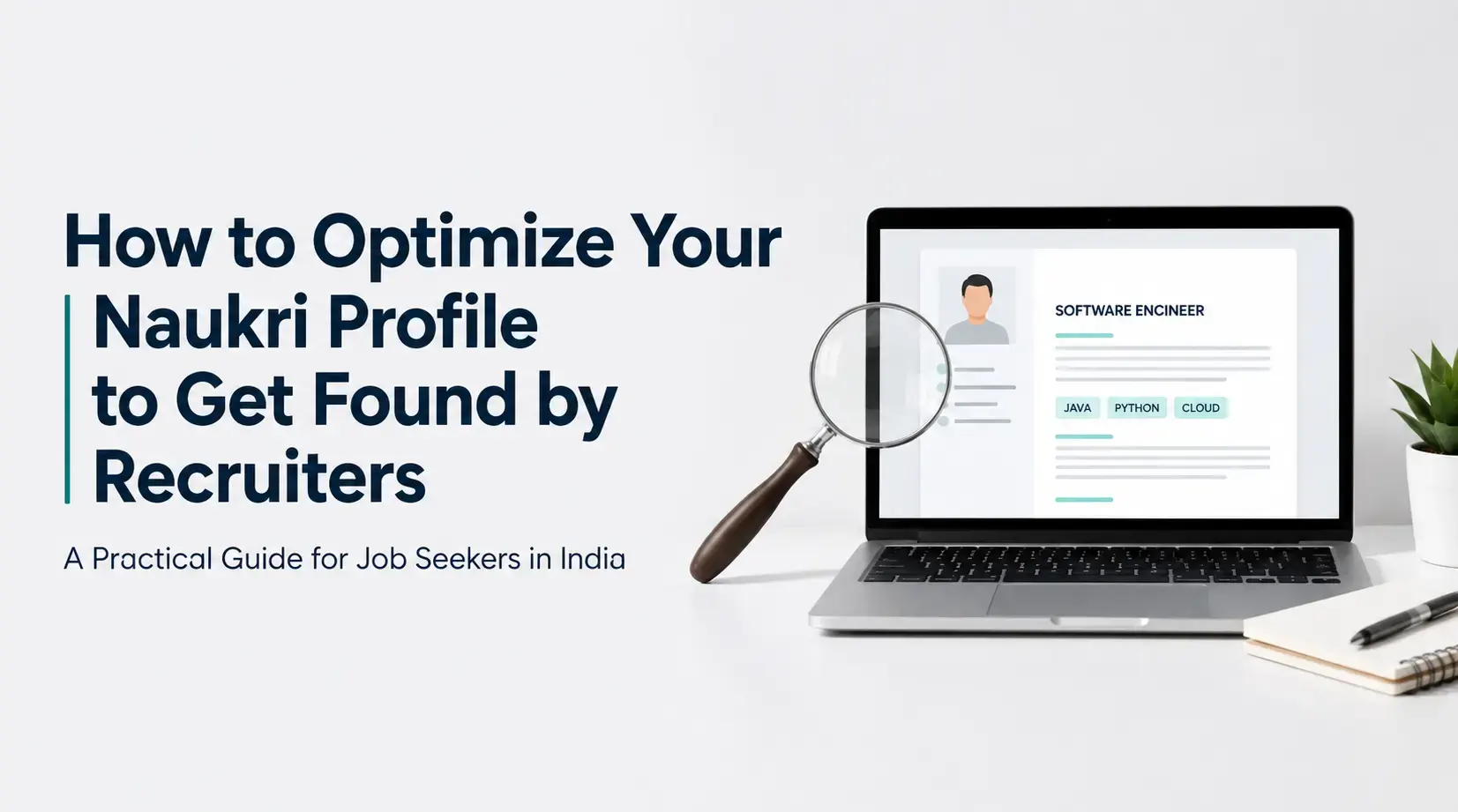
Quick Answer: Naukri profile optimization means making your real experience findable by recruiters searching Resdex using the right job titles, keywords, and complete profile fields. This guide explains exactly how recruiter search works on Naukri, what fields matter most, and what mistakes to avoid. For the AI prompts to do this optimization, see AI Prompts to Optimize Your Naukri Profile.
Introduction
"I updated my resume. I applied to jobs. But recruiters still aren't finding me."
This is one of the most common frustrations in India's job market. It usually isn't about effort candidates are applying, tailoring cover letters, following up. The missing piece is often not application volume, but discoverability: whether a profile can actually be found by a recruiter searching Naukri's resume database.
Naukri.com works two ways. You can apply directly to job postings, or a recruiter can find you first by searching the platform's resume database a feature recruiters know as Resdex. Naukri's own guidance confirms a real share of hiring happens this second way. If your profile isn't built to be found this way, applying to more jobs won't fix the underlying gap.
What Naukri Profile Optimization Actually Means
"Optimizing" a Naukri profile sometimes gets treated as a trick a way to game a hidden algorithm. It's closer to something simpler: making sure a real, accurate profile can be found and understood by the people searching for it. That involves several connected pieces:
Target role clarity — one primary role direction the whole profile supports, rather than a profile trying to be visible for five unrelated job titles at once.
Keyword alignment — using the terms recruiters and job descriptions actually use for your skills, tools, and role.
Profile completeness — Naukri explicitly ties a higher completion percentage to better outcomes, since incomplete fields mean incomplete information for both search and human review.
Recency — Naukri's own guidance states recruiters more often contact candidates whose profiles have been recently updated.
Resume-profile consistency — your uploaded resume and your on-platform fields should tell the same story. For how ATS systems read your uploaded resume file, see our guide on why ATS rejects your resume
None of this is about deception. It's about representation: making a true profile legible to a search system and a busy recruiter.
How Recruiters Search for Candidates on Naukri
Naukri's recruiter-facing tool for searching the resume database is Resdex. Per Naukri's own documentation, Resdex's Advanced Search lets a recruiter combine parameters including keyword text, designation, experience, education, salary, year of passing out, location, institute name, functional area, industry area, and specific employers to include or exclude.
The keyword field is documented to search specific parts of a profile: the candidate's profile, summary of experience, current organization, and designation. Recruiters can combine keywords using three explicit logic types:
Any — returns profiles containing at least one of the listed keywords (an OR search)
All — returns only profiles containing every listed keyword (an AND search)
Exclude — removes profiles containing any of the listed keywords (a NOT search)
For example, a recruiter searching for a marketing hire might set Any keywords to "Marketing Manager," "Brand Manager," or "Product Manager"; All keywords to "Promotion," "Pricing," and "Product Mix"; and Exclude "FMCG" to filter out backgrounds they don't want.
What this means practically: your profile's designation, key skills, and summary language are not decorative they are the literal fields a keyword search reads. If your target job title doesn't appear anywhere in these fields, a recruiter running an "All" search for that title plus a required skill will never see you, regardless of how qualified you are.
Naukri also documents that profile completeness carries real weight the platform states directly that a complete profile increases your chance of recruiters noticing and contacting you, citing the specific example that recruiters are 40% more likely to contact profiles with a photo than those without one.
Recruiters also search LinkedIn Recruiter the same way see how recruiters search LinkedIn in India.
Why Keyword Alignment Matters
Keyword alignment is not the same as keyword stuffing. Alignment means describing your real experience using the terms the market actually uses for it.
The clearest way to find your alignment keywords is to read real job descriptions for the role you want. Open eight to ten JDs for your target title and note what repeats:
Primary keywords your target job title and the two or three skills that define the role (e.g., "Business Analyst," "Requirement Gathering," "SQL")
Secondary keywords supporting tools, methodologies, and domain terms (e.g., "JIRA," "Stakeholder Management," "Agile," "BFSI domain")
Job titles deserve particular attention because recruiters frequently search on designation directly. If your official designation was internal and unusual, a Naukri profile that only uses the internal title is invisible to a recruiter searching the market-recognized title. Naming both where accurate solves this without misrepresenting anything.
Skill variations matter too: recruiters may search "ReactJS" or "React.js" or "React" if you only ever use one spelling, you're gambling on the recruiter using the same one. This is where an AI tool is genuinely useful: not inventing new skills, but surfacing reasonable variants and synonyms of skills you already have.
Naukri Profile Optimization Checklist
Use this before saving any profile update:
Headline names your target role, key skills, and experience level not a generic phrase
Summary matches the headline's role direction and gives 2–3 concrete proof points
Key skills include both the exact terms from target JDs and their common variants/synonyms
Every listed skill is one you can speak to in an interview
Employment history uses recognizable designations, with internal titles clarified where needed
Job descriptions under each role use specific, verifiable language not copied JD boilerplate
Uploaded resume tells the same story as the profile (no contradicting dates, titles, or skills)
Education and certifications are current and complete
Preferred location, notice period, and salary expectations are accurate not aspirational placeholders
Profile completion percentage is as close to 100% as your real information allows
Profile has been reviewed and updated recently with a genuine change not a cosmetic one
7 Naukri Optimization Mistakes to Avoid
1. Keyword stuffing. Repeating a term unnaturally, or listing skills you don't actually have, has no documented ranking benefit and reads as unnatural to a human recruiter reviewing your profile after the search.
2. A generic headline. "Seeking a good opportunity" or "Hardworking professional" matches no keyword search and tells a recruiter nothing in the few seconds they spend scanning results.
3. Unrelated skills added "just in case." A profile trying to be found for five different roles usually reads as unfocused for all five, and can pull you into irrelevant search results.
4. Letting AI invent achievements. An unconstrained AI prompt will often produce a fluent-sounding metric or outcome you never reported. If you can't explain a line in an interview, remove it before you save it.
5. Copying JD language wholesale without matching experience. Mirroring vocabulary is useful; claiming a requirement you don't actually meet sets up a mismatch the interview will expose.
6. Inconsistent designations across the profile and resume. A mismatch between your resume title and your profile's employment section confuses whoever reads it next — human or automated.
7. Optimizing for every possible job instead of one target role. A profile without a clear direction is harder for a keyword search and a human reader to place, even if every individual fact in it is accurate.
Does Updating Your Naukri Profile Increase Recruiter Calls?
Naukri states directly: "We recommend you to update your Profile regularly. Recruiters often contact only those candidates who have recently updated their profiles." That's a real, documented statement recency matters.
What Naukri has not published is a specific interval (daily, weekly, every 10 days) or a numeric ranking boost. The widely repeated claims found across job-search blogs such as "update every 10–14 days for an algorithm boost" are not attributed to any Naukri or InfoEdge publication. They may be directionally reasonable, but they are not verified facts.
A more honest way to frame it: keep your profile genuinely current, updating it when something real has changed a new skill, a completed project, or a fresh look at your target-role keywords rather than making cosmetic edits purely to trigger a freshness signal.
Can AI Guarantee Naukri Recruiter Visibility?
No. AI tools have no access to Naukri's internal search or ranking systems, no way to verify how your specific profile performs in a live recruiter search, and no ability to guarantee that a human recruiter will click through and contact you.
What AI can do is help you represent your real experience more clearly, aligned with the language recruiters and job descriptions actually use which improves the odds that a profile is understood correctly when it is found. Any tool or service that promises guaranteed recruiter calls is making a claim it cannot actually support.
For the AI prompts that help you do this accurately, see Part 2 of this guide: AI Prompts to Optimize Your Naukri Profile.