Career Insights
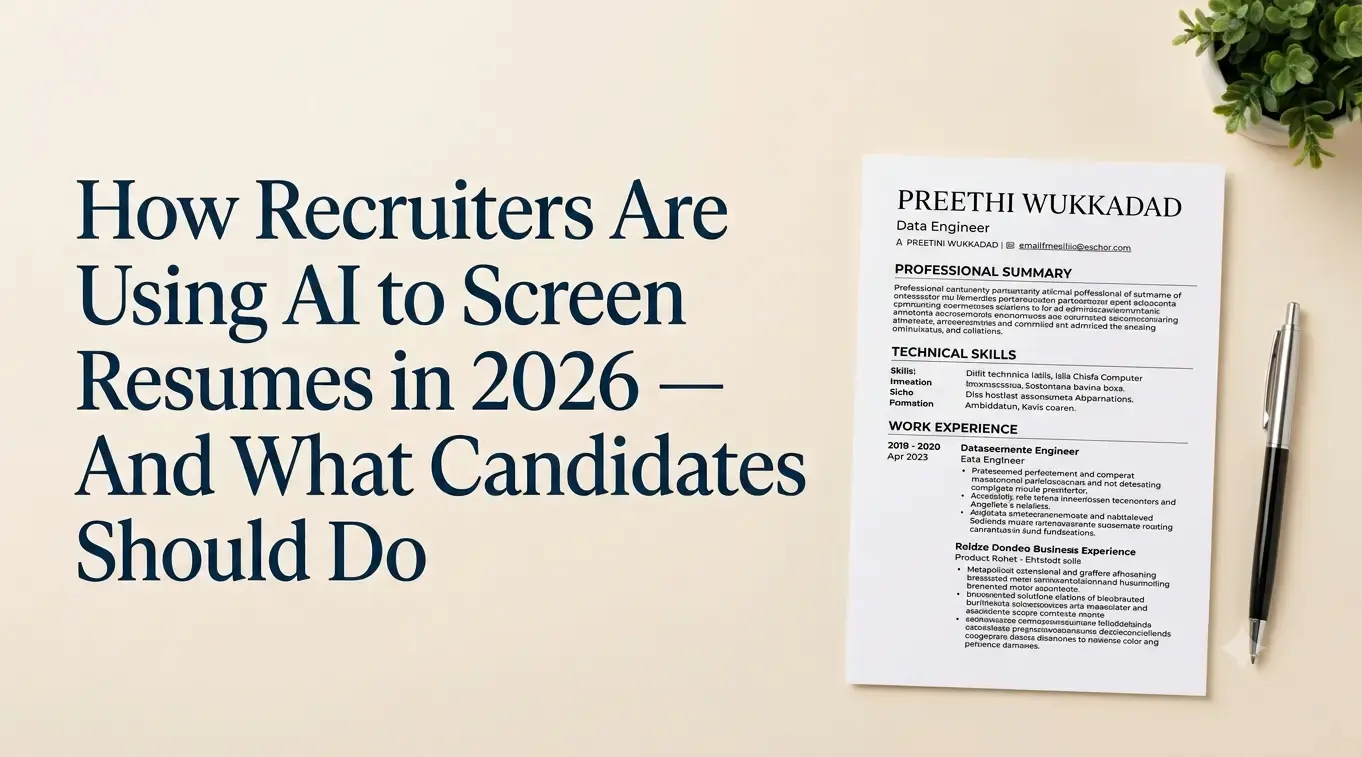
How Recruiters Are Using AI to Screen Resumes in 2026 — And What Candidates Should Do
AI is not simply rejecting your resume before a human sees it. Here’s how recruiters actually use AI in 2026 plus a practical 5-step process to make your resume clear, relevant, and easy to match
By Kavya · 23 Sept 2026
Quick Answer: In 2026, AI is used in recruitment for parsing, matching, ranking, and recommendations not simply to reject resumes automatically. The best response is not to "beat the algorithm" but to make your real experience clear, relevant, and easy to verify using the language of the job description.
AI is changing resume screening in 2026 but it is not simply a robot rejecting resumes before a human ever sees them.
Many candidates still ask: "Will AI reject my resume before a recruiter sees it?" The reality is more nuanced. AI now supports resume parsing, candidate search, job-to-candidate matching, ranking and recommendations, assessments, and recruiter workflow automation and different employers use these capabilities in different ways.
This is particularly relevant for candidates in India, where platforms like Naukri, LinkedIn, and company career portals are the primary hiring channels and AI-assisted screening is increasingly common across IT services companies, product startups, and BFSI firms.
This article explains how recruiters actually use AI today and what you can do to make your experience clear, relevant, and easy to verify.
How AI Is Being Used in Recruitment in 2026
In 2026, AI shows up in recruiting in several distinct ways.
Resume parsing — Extracts skills, job titles, dates, education, and other structured information from resumes and profiles.
Candidate search — Helps recruiters find people who match certain skills, experiences, or qualifications, often going beyond exact keywords.
Job-to-candidate matching — Compares job descriptions and candidate profiles to estimate fit based on skills, seniority, domain, and other signals.
Candidate ranking and recommendations — Surfaces "top matches" or recommended candidates for a role instead of showing every applicant in raw order.
Assessments and interview support — Powers screening questions, AI-led pre-interviews, and evaluation summaries that recruiters review.
Recruiter workflow automation — Drafts outreach messages, summarizes candidate profiles, and helps move candidates through pipeline stages.
Platforms like LinkedIn describe AI hiring agents that can source candidates, review applicants, match candidate information to job qualifications, and summarize relevant qualifications. Their AI-assisted search can also identify relevant qualifications beyond exact profile keywords.
Is AI Automatically Rejecting Your Resume?
Not necessarily.
An AI-assisted recruiting workflow might look like this:
Parse → Match → Rank → Recommend → Recruiter Review
But another employer may use automation differently. Some organizations use AI mainly to organize and surface candidates; others add automated filters at specific stages.
The role of AI varies by employer, recruiting platform, workflow, and hiring process. SHRM's 2026 coverage similarly describes AI being used for resume screening, candidate ranking, and assessments, while emphasizing the importance of human judgment and validation.
So instead of asking "Will AI reject my resume?" a better question is: "How might AI be used in this employer's process, and how can I make my experience easy to understand?"
What AI Looks For in a Resume
It is not a secret algorithm you need to hack. Think in terms of what any system trying to match you to a job would care about:
Role relevance — Does your experience clearly relate to the target role and level?
Skills — Are relevant technical and functional skills represented in a way the system can recognize?
Experience — Can the system understand your job titles, dates, responsibilities, and achievements?
Context — Are skills demonstrated through actual work, not just listed? For example, "Led a team of 5 engineers" is clearer than "Leadership skills."
Consistency — Do your resume, LinkedIn profile, and application information tell a consistent career story?
This aligns closely with how AI-assisted tools are described: matching candidate information to job qualifications and evaluating how well profiles align with role requirements.
Why a Good Candidate Can Still Be Hard to Match
Even strong candidates can be under-matched if their experience is not expressed in recognizable terms.
Example 1 — Sales/CRM
Candidate writes: "Used a customer relationship platform to manage pipelines and close deals."
Job description says: "Experience with Salesforce CRM required."
If you genuinely have Salesforce experience, using the specific term improves clarity for both AI and recruiters. But you should never add "Salesforce" if you have never used it.
Example 2 — Data/Engineering
Candidate writes: "Built data pipelines for analytics."
Job description says: "Experience with ETL workflows and orchestration tools."
If your work involved ETL and tools like Airflow, dbt, or similar, naming them directly helps the system connect your experience to the role.
Core principle: Match the language of the job description when it truthfully describes your experience.
AI-Friendly Does Not Mean Keyword Stuffing
One of the biggest mistakes candidates make is treating "AI-friendly" as "more keywords."
Bad approach:
Java, Java Developer, Java Backend, Java Spring, Java API, Java REST, Java Microservices, Java Cloud…
Better approach:
Developed REST APIs using Java and Spring Boot for enterprise backend applications, supporting high-traffic microservices on cloud infrastructure.
The second version gives both automated systems and human recruiters meaningful context about what you actually did.
LinkedIn itself emphasizes that candidates may use AI to draft or refine resumes and cover letters, but the materials should accurately reflect their real experience, skills, and impact not just pack in buzzwords.
Formatting Still Matters
Clean formatting helps machine readability and human scanning.
Recommended:
Standard section headings (Experience, Education, Skills)
Clear job titles and company names
Consistent date formats (e.g., Jan 2022 – Present)
Simple bullet points for responsibilities and achievements
Readable fonts and reasonable line spacing
Text-based information instead of images of text
A conventional resume structure
Avoid unnecessary complexity such as:
Important information embedded in images or graphics
Excessive decorative elements or text boxes
Unusual or highly custom section structures
Overly complicated tables or multi-column layouts
That does not mean "tables will always fail ATS." Different systems handle documents differently. But complex layouts can create parsing problems in some systems, so a clean structure reduces unnecessary risk. For a deeper look at how ATS systems reject resumes, see our guide on why ATS rejects your resume and how to fix it.
Don't Try to Beat the System — Make Your Experience Easy to Understand
There is no universal AI screening algorithm that candidates can reverse-engineer.
Instead of trying to "beat AI," focus on:
Truthful, relevant keywords
Clear descriptions of your actual experience
Simple, readable formatting
Evidence of impact (metrics, scope, outcomes)
Consistent career information across resume and profiles
Job-specific tailoring where it honestly reflects your background
This is a stronger, more sustainable approach than chasing mythical "ATS hacks."
How to Tailor Your Resume for AI-Assisted Screening
Use this practical 5-step process for each important application.
Step 1: Read the Job Description
Identify:
Target role and level
Core skills and tools
Required vs. preferred qualifications
Industry terminology and certifications
Experience expectations (years, domains, environments)
Whether you are applying through Naukri, LinkedIn, or a company portal in India, the job description is your most reliable guide to what the system and the recruiter are looking for.
Step 2: Separate Required From Preferred Skills
Do not treat every word in the JD equally. Focus first on the must-haves, then the nice-to-haves.
Step 3: Map Your Actual Experience
Ask yourself: "Where have I genuinely demonstrated this skill?" and "Which projects, roles, or results show this clearly?" Only map what you can truthfully claim.
Step 4: Use the Employer's Terminology Where Accurate
If the JD says Power BI and you genuinely use Power BI, do not replace it with a vague phrase like "business reporting tool." If you have used similar tools but not Power BI specifically, describe what you have used and how it relates.
Step 5: Add Evidence
Instead of: Managed cloud infrastructure.
Use: Managed Azure virtual machines, storage accounts, and automation workflows across production environments supporting 200+ services.
Only use claims you can verify in an interview.
AI Screening vs Human Review
A candidate may encounter multiple stages:
Application → Resume/profile parsing → Search or matching → Ranking/recommendation → Recruiter review → Assessment/interview → Hiring decision
But not every employer uses all these stages, and not every stage is AI-driven.
LinkedIn's materials describe AI as supporting recruiters and surfacing relevant information, while noting that AI outputs can be inaccurate and that steps are taken to improve accuracy and verification. In practice, AI often organizes and summarizes information so humans can make better, faster decisions.
In India, recruiters at IT services companies, product startups, and BFSI firms use LinkedIn Recruiter and Naukri Resdex alongside their ATS meaning your profile visibility on both platforms matters as much as your resume file. See how recruiters search LinkedIn in India and how to optimize your Naukri profile for the full picture.
What About AI Bias?
AI can improve efficiency, but it can also reproduce problems in the data or processes used to build and validate systems.
SHRM has highlighted concerns about:
Over-reliance on algorithmic hiring judgments
Insufficient validation of AI-enabled selection processes
Potential bias in training data or evaluation criteria
Your takeaway: AI is a tool in the hiring process not an infallible judge of candidate quality. Human oversight, transparent processes, and candidate awareness all matter.
What About Candidate Privacy?
Candidates should understand what information they are submitting and how it may be used.
For example, LinkedIn states that its AI hiring agents can use profile information such as skills, experience, location, education, certifications, Open to Work preferences, and uploaded resumes when available to recruiters.
As you prepare your resume and profiles, consider:
What information is publicly visible on LinkedIn and other platforms?
Which resume versions are uploaded to job boards or company portals?
What information are you submitting through each application?
Are all your claims accurate and verifiable?
Are you including any sensitive personal details unnecessarily (e.g., full address, ID numbers)?
Keeping your data accurate, minimal, and consistent reduces risk and improves trust.
The 2026 Resume Checklist
Before applying, run through this checklist.
Content
Target role is clear
Relevant skills are included
JD terminology is used where truthful
Experience demonstrates those skills with concrete examples
Achievements include evidence where available (metrics, scope, outcomes)
Structure
Job titles and dates are consistent
Formatting is simple and readable
No unnecessary graphics or images of text
Standard section headings are used
Integrity
No keyword stuffing
No unsupported or exaggerated claims
Resume broadly matches your LinkedIn and Naukri profile information
All claims can be explained and defended in an interview
Final: Don't Write Your Resume for AI Alone
AI is changing how recruiters search, screen, and organize candidate information. But that does not mean candidates should try to write resumes for machines.
The stronger approach is to make your real experience clear, relevant, searchable, and easy to verify.
Use the language of the job description when it accurately describes your experience. Show evidence instead of stuffing keywords. Keep the formatting readable. Make sure your resume tells the same career story as your LinkedIn and Naukri profiles.
Do not try to beat AI. Make it easier for both AI-assisted systems and human recruiters to understand why your experience is relevant.