Career Insights
How Long Should a Resume Be? One Page vs. Two Pages, Explained
One page or two? The answer is not a rule it depends on your career stage, experience, and what you need to show. Here is how to decide, with a clear framework for freshers and experienced professionals.
By Kavya · 26 Oct 2026
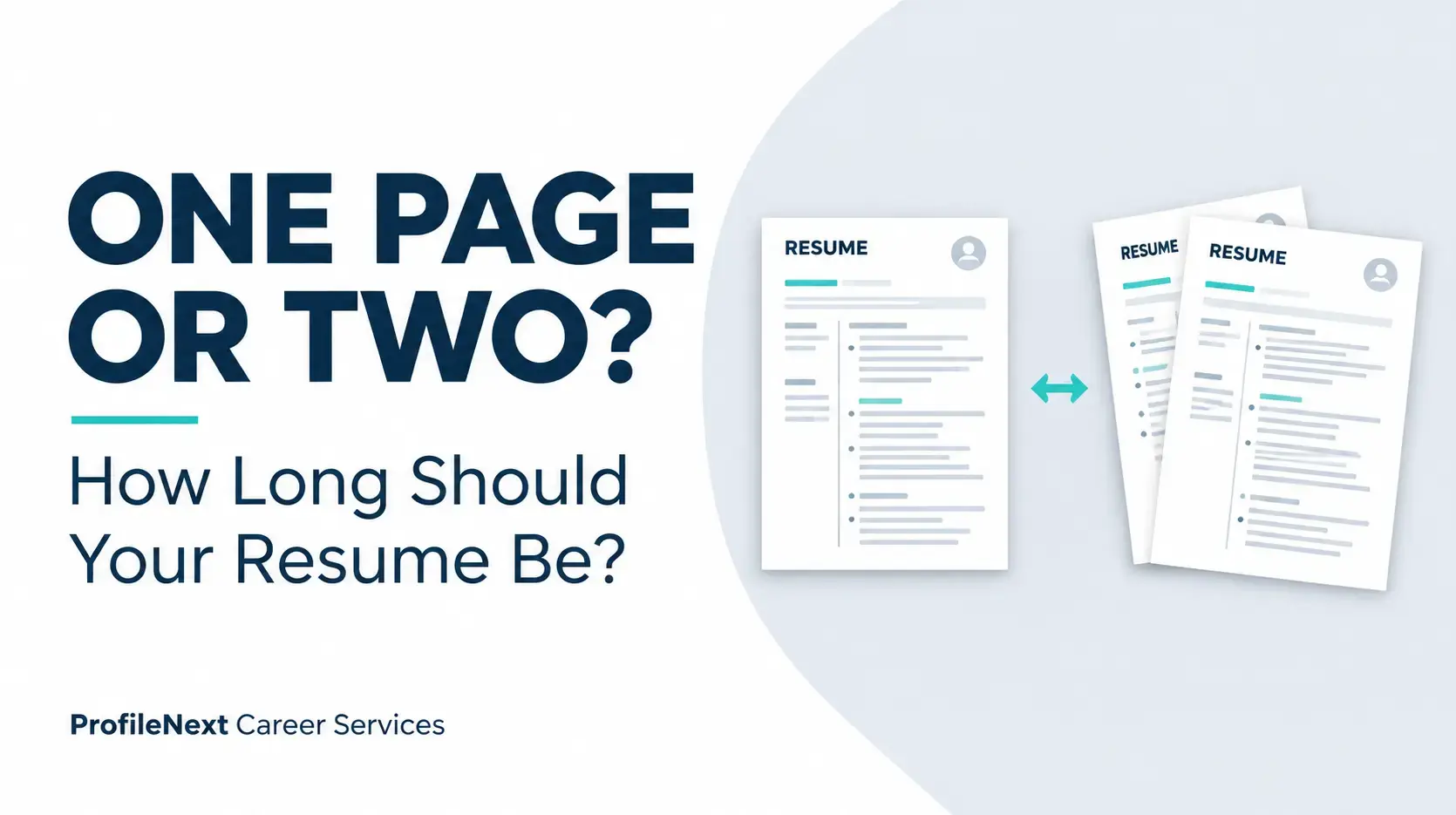
Quick Answer: Most freshers and early-career professionals should start with a one-page resume. A two-page resume is appropriate when you have relevant experience, projects, achievements, or specialized skills that cannot be presented clearly on one page. The right length is the one that presents your strongest evidence clearly not the one that hits a specific page count.
Should your resume be one page or two? If you have searched for resume-writing advice, you have probably heard that recruiters prefer one-page resumes. You may also have seen experienced professionals using two pages to explain their work history, skills, and achievements.
So, which approach is right?
In India's competitive job market where recruiters on Naukri, LinkedIn, and company portals receive hundreds of applications for the same role a resume that is clear, relevant, and easy to scan matters far more than hitting a specific page count.
At ProfileNext, our view is simple: your resume should be as short as possible, but as long as necessary to present your strongest relevant evidence.
A one-page resume is often a good starting point for freshers and candidates with limited experience. A two-page resume can be entirely reasonable when your work history, projects, technical skills, or achievements need more space.
Choosing two pages is not the mistake. The mistake is filling either one or two pages with information that does not help an employer understand why you are suitable for the role.
In this guide, we will explain how to decide your resume length, when two pages make sense, whether freshers can use two pages, and what to remove before finalizing your resume.
Quick Answer: Should Your Resume Be One Page or Two?
Career stage | Recommended starting point | When to consider more space |
|---|---|---|
Fresher or recent graduate | One page | Relevant internships, projects, research, certifications, or achievements may justify a second page |
1–5 years of experience | One page, if readable and complete | Multiple relevant roles, projects, or specialized responsibilities |
5–10 years of experience | One or two pages | Several roles, meaningful achievements, technical expertise, or leadership responsibilities |
10+ years of experience | Two pages may be appropriate | Relevant career progression, strategic contributions, projects, and leadership impact |
Senior or specialized professional | Based on role requirements | Complex projects, specialist expertise, or substantial achievements that demonstrate fit |
These are starting points, not rigid rules. The right length depends on the relevance, clarity, and evidence in your resume not years of experience alone. A professional with eight years of repetitive responsibilities may need less space than someone with four years of highly specialized project experience.
Always check the employer's instructions. If a job application explicitly asks for a one-page resume or imposes a page limit, follow that requirement.
Can a Resume Be Two Pages?
Yes. A resume can be two pages if the second page adds useful, relevant information.
A two-page resume may be appropriate when you need to show:
Relevant experience across multiple companies or roles
Projects that demonstrate your technical or professional capabilities
Achievements supported by real outcomes or measurable results
Progression into leadership, specialist, or managerial responsibilities
Certifications, training, or domain knowledge relevant to the target position
For example, consider a software engineer with seven years of experience across Java development, API integration, database optimization, and production support. Trying to fit all relevant responsibilities, technical projects, and achievements into one page may force the candidate to use tiny text or remove useful evidence. A well-organized two-page resume could communicate that experience more clearly.
Now consider a candidate with the same seven years of experience whose resume repeats phrases such as "responsible for development," "worked with the team," and "handled project tasks" across several roles. Adding another page will not improve that resume. The issue is the quality of the content, not the available space.
The rule is simple: use page two to strengthen your case, not to extend your employment history unnecessarily.
Can a Resume Be Longer Than One Page?
Yes. More than one page is acceptable when the additional content is relevant, readable, and necessary for the role. However, a longer resume is not automatically a stronger resume.
Imagine two candidates applying for a Business Analyst position.
Candidate A has a one-page resume. It includes relevant experience in requirement gathering, stakeholder communication, user stories, process documentation, and User Acceptance Testing. The content is specific and easy to scan.
Candidate B has a two-page resume. It includes similar relevant experience but also explains additional projects, stakeholder responsibilities, and testing coordination from different roles. Both resumes may be effective because they communicate relevant qualifications.
Now imagine Candidate B adds unrelated activities, generic job duties, and repeated skills simply to fill the second page. The extra content makes the resume harder to scan without improving the candidate's suitability.
A page count cannot compensate for weak positioning.
According to Indeed India's resume-length guidance, content quality and readability matter more than forcing a resume into one page.
Can Freshers Have a Two-Page Resume?
Yes, a fresher can have a two-page resume, but one page is usually a sensible starting point.
Freshers generally have fewer full-time professional experiences to document. A concise page can often communicate their education, skills, and most relevant evidence effectively. However, some freshers have substantial project work, internships, research experience, technical training, or relevant leadership activities. A second page may be reasonable when these details genuinely strengthen the application.
What should freshers include?
Depending on the job, a fresher resume can include:
Education and relevant academic qualifications
Technical or professional skills relevant to the role
Academic, personal, or industry projects
Internships and practical training
Certifications relevant to the target position
Relevant achievements, competitions, or leadership experience
For example, a fresher applying for a Java Developer role may highlight a Java-based application, database integration, REST API development, and an internship involving relevant programming tasks. A fresher applying for a Business Analyst role might highlight a requirement-documentation project, process mapping, user stories, test scenarios, and UAT-related academic or internship experience provided these reflect actual work completed.
When should a fresher avoid two pages?
A second page is probably unnecessary when it contains:
Repeated skills already listed elsewhere
Long descriptions of routine academic activities
School-level details that do not support the target role
Unrelated hobbies or personal information
Large spaces and oversized headings used to increase page count
Generic statements that could describe almost any applicant
The goal is not to make a fresher resume look experienced. It is to make the candidate's existing skills and potential easy to understand.
Fresher takeaway: Start with one page. Move to two only when the additional content provides genuine evidence of suitability.
When Should Experienced Professionals Use Two Pages?
For experienced professionals, the decision depends on the complexity and relevance of their career history. A second page may help when your professional story includes several meaningful roles, specialized responsibilities, significant projects, leadership experience, or achievements that cannot be presented clearly on one page.
You have worked across multiple companies
If you have moved between organizations or roles, you may need sufficient space to distinguish your responsibilities and contributions. Avoid copying the same job description into every position. Explain how your work differed, what you owned, and how your responsibilities developed.
You have technical projects worth explaining
Professionals in software development, cloud engineering, DevOps, data engineering, cybersecurity, and other technical fields may need space to demonstrate project scope and tools used. Include the technical details that support the job you are targeting rather than listing every technology you have encountered.
You have progressed into leadership
Managers and senior professionals may need to describe team leadership, project ownership, process improvement, stakeholder management, risk management, or business impact. Relevant scope and outcomes can justify extra space. A long list of routine managerial responsibilities usually cannot.
You are changing careers
If you are moving into a different field, additional space may help connect your earlier experience with the requirements of your new target role. However, more content does not automatically make the career transition clearer. Prioritize transferable skills and relevant evidence.
There is no universal experience threshold at which a two-page resume becomes compulsory. Even a senior professional may have a strong one-page resume for a narrowly defined role, while another candidate may need two pages to explain a more complex background.
Some fields also use different conventions. Academic CVs, research applications, and certain government or senior-level applications may require more detailed documents. In those cases, follow the employer's or institution's specific requirements.
How to Decide Whether Your Resume Needs a Second Page
Before changing the length, ask yourself five questions.
1. Does every section support my target role?
Review your resume against the job description. If you are applying for a Data Analyst role, relevant SQL experience, reporting, data validation, dashboard development, and analytical projects may deserve priority when they reflect your background. Unrelated information should not receive equal space simply because it is part of your history.
2. Have I explained achievements, not just duties?
Compare these examples.
Generic statement: "Responsible for preparing reports and coordinating with stakeholders."
More informative statement, when accurate: "Prepared monthly sales reports using Excel and SQL and coordinated with business stakeholders to resolve data discrepancies."
The second example communicates the work more clearly. Where you have reliable evidence, include genuine outcomes such as time saved, error reduction, revenue supported, or the scale of a project. Never invent numbers to make your resume appear stronger.
3. Am I repeating information?
Look for duplicated skills, repeated responsibilities, and similar bullets across different jobs. Some repetition is useful when it shows how a skill was applied in a real role. Repetition without additional evidence is not.
4. Is the resume readable at its current length?
Do not force a resume into one page by shrinking the font excessively, removing useful spacing, or turning every bullet into a dense paragraph. A readable two-page resume is generally a better choice than a cramped one-page document that hides the most important information.
5. Does page two add value?
Read the second page separately. Would a recruiter find relevant achievements, experience, projects, or qualifications there? Does it complete the story started on page one? If the second page mainly contains unrelated information or repeated duties, edit the resume before keeping it.
What Should Go on Page One of Your Resume?
Whether your resume is one page or two, the first page needs to communicate your fit quickly. Prioritize the following information based on your experience and target role:
Contact information — your name and professional contact details
Professional summary — a concise introduction that describes your experience, specialization, and professional strengths when a summary is useful for your career stage
Core skills — the most relevant technical, functional, or industry skills for the target position
Relevant experience — your most recent or most relevant roles, supported by specific responsibilities and achievements
Strong evidence — relevant projects, measurable contributions, domain expertise, or other qualifications that distinguish your application
Education, certifications, and additional projects can be placed according to their relevance. For a fresher, education and projects may deserve a prominent position. For an experienced candidate, recent professional experience may need to come first.
Do not reserve all your strongest achievements for page two. The opening section of the resume should already make a clear case for your suitability.
Does Resume Length Affect ATS Screening?
There is no good reason to choose one page solely because you assume an Applicant Tracking System will automatically reject two-page resumes. Resume length alone does not determine whether an ATS can read your resume. ATS tools typically focus on how clearly the document presents sections, job titles, dates, skills, and relevant experience.
A two-page resume will not be rejected automatically because of its length. However, unclear formatting, missing dates, unusual section names, graphics-heavy layouts, or poorly structured content can create parsing problems.
To make your resume easier to read:
Use standard section headings such as Work Experience, Education, and Skills
Keep job titles, company names, and dates clear and consistent
Use straightforward bullet points and a readable layout
Include relevant job-description terminology naturally, where it accurately describes your skills or experience
Follow the employer's requested file type and application instructions
On Naukri, a .docx file is the most universally compatible format. On LinkedIn Easy Apply, PDF and Word are both accepted. Check the application instructions for each role before submitting.
Avoid adding irrelevant keywords, hiding text, or repeating skills just to make a resume appear more ATS-friendly. A one-page resume can still be poorly structured, and a two-page resume can still be clear and relevant. Page count is not a substitute for checking the document's actual quality.
Signs Your Resume Is Too Long
Your resume may need editing if:
The same responsibilities appear repeatedly — several bullets communicate nearly identical tasks without showing additional scope or impact
Older roles take up too much space — earlier experience receives more attention than recent work that is more relevant to your target position
The content is not tailored — the resume includes extensive details that do not support the role you are applying for
The formatting is difficult to read — dense paragraphs, cramped spacing, or inconsistent headings make important details harder to find
Page two adds little value — removing the second page would make little difference to how well the resume demonstrates your suitability
These signs matter more than the page count alone.
Signs Your Resume May Be Too Short
A one-page resume is not automatically effective. It may be too short if:
Important skills required for the target role are missing
Your work experience is described in vague, generic terms
Relevant projects or internships have been omitted
Achievements or professional contributions are not explained
The formatting has been compressed so aggressively that the document is uncomfortable to read
The purpose is not to hit a particular number of pages. It is to include enough relevant information for an employer to understand your qualifications without making them work through unnecessary detail.
ProfileNext's Approach: Evidence Before Page Count
At ProfileNext Career Services, we believe resume length should follow evidence, career stage, and role requirements.
We do not recommend adding a second page just because someone has several years of experience. Nor do we recommend deleting important, relevant details simply to meet an arbitrary one-page target.
Our approach is to:
Identify the job or role family the candidate is targeting
Prioritize the skills and experience relevant to that target
Present real responsibilities, projects, and achievements clearly
Remove repetitive, outdated, or unrelated information
Maintain readable formatting and a logical section order
Ensure the strongest relevant evidence appears early in the document
For one candidate, this may result in a focused one-page resume. For another, two pages may be necessary to represent their experience properly.
For guidance on how to use AI to strengthen your resume content without making it generic, see our AI resume improvement guide.
The right length is the one that presents the candidate's strongest case with the least unnecessary information.
Final Verdict: One Page or Two?
The one-page versus two-page debate is settled by one principle: relevance comes before length.
For freshers, start with one page and include only the strongest evidence of skills and potential. For experienced professionals, use the space required to demonstrate relevant work, accomplishments, and expertise without repeating information.
If two pages help an employer understand your qualifications, use two. If one page communicates your fit clearly, keep it to one.
Do not chase a page count at the expense of clarity. Build a resume that is easy to scan, tailored to the job, and supported by genuine evidence.