Career Insights
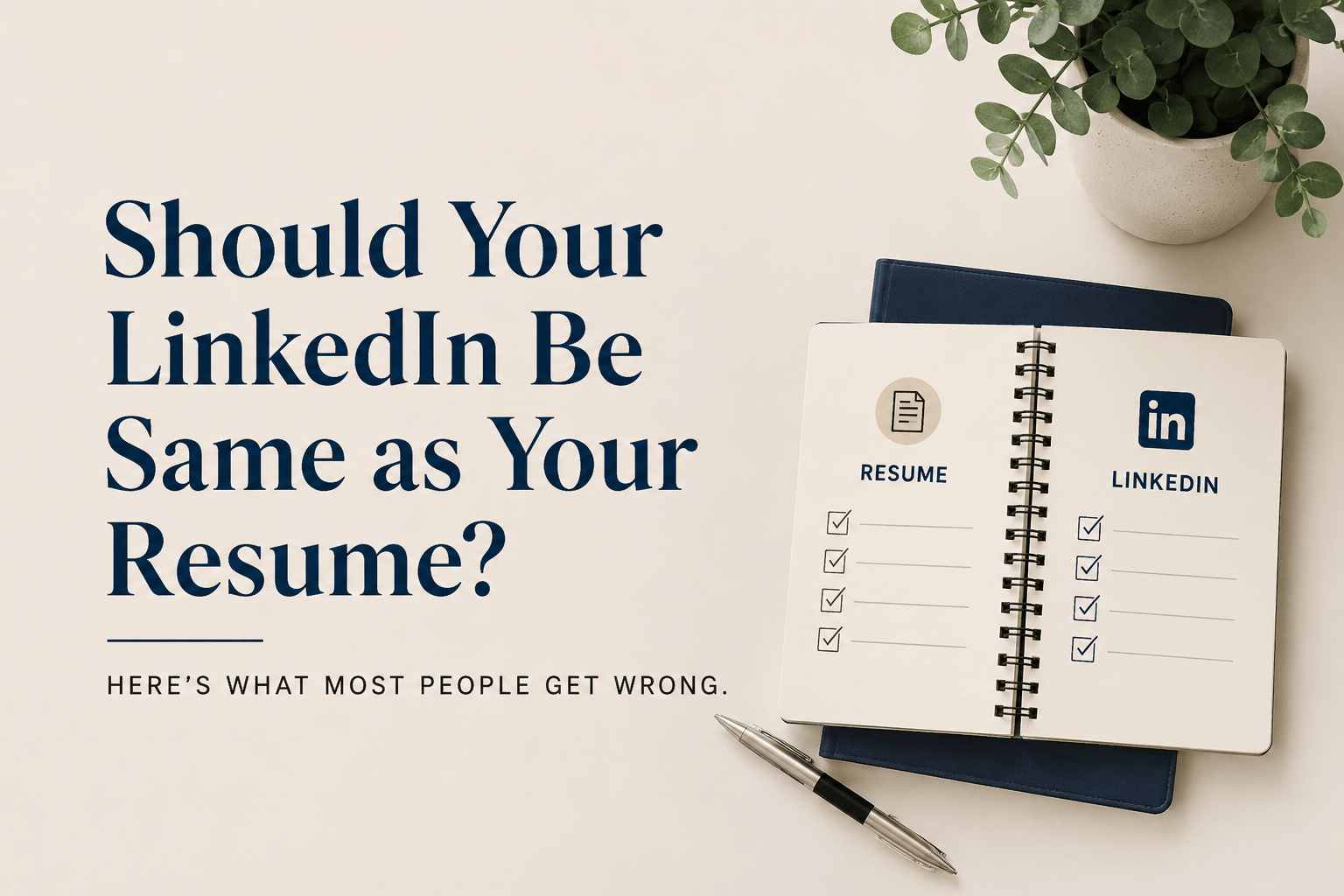
Should your Linkedin be same as your Resume
Your LinkedIn and your resume tell the same story but they don’t have to tell it exactly the same way
By Harshini Prasad · 23 Aug 2026
Be honest: when was the last time you updated your LinkedIn profile?
If your answer is “when I updated my resume,” you’re not alone.
A lot of people approach LinkedIn exactly like they approach their resume. They copy their job titles, paste in their experience, add a few skills, upload a professional photograph, and consider the job done.
But that misses the point of LinkedIn.
Your resume is designed to be tailored for a particular opportunity. Your LinkedIn profile has a different job. It gives someone a chance to understand your career beyond a two-page document.
It can show what you have worked on, what you are interested in, what you are learning, and even what kind of opportunities you are looking for.
So, if your LinkedIn profile is simply your resume in a different format, it might be time to rethink it.
Your Resume Tells Them What You Did. LinkedIn Can Tell Them More.
Imagine your resume says:
“Content Intern – 3 months”
It tells a recruiter where you worked and what your role was.
But what did you actually do there?
Maybe you worked on social media campaigns. Maybe you wrote content for different audiences. Maybe you learned how to use analytics. Maybe the experience made you realise that you enjoy strategy more than writing.
Those details are what make your experience interesting.
Your LinkedIn profile gives you room to add that context.
You can talk about a project you worked on, share something you learned, or explain how an experience changed the way you think about your career.
Your resume needs to be concise. Your LinkedIn profile doesn't have to tell the entire
6 Mistakes To Avoid While Making Your Resume
You Don't Need to Have Your Career Figured Out
Another reason people hesitate to build their LinkedIn presence is that they think they need an impressive career story first.
You don't.
Your first internship doesn't have to be at a well-known company. Your first job doesn't have to be your dream job. And you certainly don't need to know exactly where you will be five years from now.
Your interests will change. Your skills will change. Your career might take a direction you didn't expect.
Your LinkedIn profile can change with you.
If you're learning something new, talk about it. If you worked on a project you're proud of, share it. If you attended an event that made you think differently about your industry, write about what you took away from it.
You don't have to pretend you have everything figured out.
Being curious about where you're going is perfectly fine.
Stop Filling Your Profile With Words That Say Nothing
Take a look at a few LinkedIn profiles and you'll probably notice the same words everywhere:
“Passionate.”
“Results-driven.”
“Dynamic.”
“Hardworking.”
“Ambitious.”
There's nothing wrong with these words, but the problem is that almost everyone uses them.
What actually makes your profile stand out is specificity.
Instead of saying you're passionate about marketing, what part of marketing interests you?
Instead of saying you're a strong communicator, where have you demonstrated that?
Instead of saying you're interested in technology, what are you currently learning or exploring?
The more specific you are, the easier it becomes for someone reading your profile to understand what you actually bring to the table.
Your LinkedIn profile should sound like a person wrote it, not like it came from a collection of corporate buzzwords.
Recruiters Aren't Just Looking at Your Profile
There's another important reason you shouldn't treat LinkedIn like an online resume.
Recruiters aren't necessarily waiting for you to apply to their job.
They're searching.
They might be looking for someone with a particular job title, skill set, location, or level of experience. And if your profile doesn't communicate those things clearly, you could be overlooked even if you're a good fit.
That means your LinkedIn profile needs to work for two audiences: the person reading it and the search behind it.
How Recruiters Search LinkedIn In India And How To Make Sure They Find You
This doesn't mean filling your profile with keywords until it becomes unreadable.
It means being clear about what you do.
If you're a data analyst, say that.
If you work with specific tools or technologies, mention them.
If you're targeting a particular kind of role, make that direction clear.
Don't make a recruiter guess what you do from a clever headline.
Your Profile Is Only the Beginning
A good LinkedIn profile isn't particularly useful if you never use LinkedIn.
You don't need to post every day. You don't need to become a career influencer. And you definitely don't need to share every certificate you complete.
Start smaller.
Follow people whose careers interest you. Read what they post. Leave a thoughtful comment when you have something to add. Share an interesting project or something you've learned.
And when you reach out to someone, have a reason.
“Hi, please help me get a job” isn't networking.
“Hi, I came across your work in product marketing and I'm currently exploring the field. I really liked your perspective on X” is a conversation.
The goal isn't to collect hundreds of connections.
It's to build a professional network that actually means something.
Your LinkedIn Profile Should Grow With Your Career
You are not going to have the same LinkedIn profile five years from now.
And that's the point.
The profile you create as a student will look different from the one you have after your first job. Your first job will lead to new skills, new experiences, new interests and probably a few changes in direction.
Let your profile reflect that.
Think of your resume as the document you customise when you're applying for something.
Think of LinkedIn as the place where your professional story keeps developing between those applications.
One isn't more important than the other.
They simply serve different purposes.
So the next time you open your LinkedIn profile, don't ask yourself, “Does this look like my resume?”
Ask a better question:
“If someone knew nothing about me and landed on my profile today, would they understand what I do, what I'm good at, and where I'm headed?”
If the answer is no, you probably have some updating to do.
Build a LinkedIn Profile That Works For You
Your LinkedIn profile shouldn't just document your career. It should help position you for where you want to go next.
At Profilenext Career Services LinkedIn optimisation is approached from a recruiter's perspective — helping you communicate your experience, skills, and career direction in a way that is clear, credible, and discoverable.
Ready to make your LinkedIn profile work harder for your career?