Career Insights
How to Research a Company Before an Interview in India (2026)
Learn how to research a company before an interview in India with a practical 7-step checklist. Discover how to use LinkedIn, AmbitionBox, Glassdoor, company news, BSE/NSE filings, and job descriptions to prepare stronger interview answers and questions.
By Kavya · 20 Apr 2026
Quick Answer
To research a company before an interview in India, check the official website, job description, LinkedIn, AmbitionBox, Glassdoor, recent company news, and relevant financial or industry sources.
For listed companies, review BSE/NSE filings, annual reports, and investor presentations. For startups, look at founder backgrounds, funding news, hiring activity, product updates, and employee reviews.
Spend 60–90 minutes researching before a first-round interview. For final rounds or senior roles, spend additional time understanding the company’s market, team priorities, and the interviewer’s professional background.
Before the interview, you should be able to explain:
What the company does and who it serves
What the role contributes to the business
One recent company update or priority
Why your background fits the role
Two intelligent questions to ask
You have cleared the ATS. Your resume has been shortlisted. The interview is confirmed. Now comes the preparation many candidates miss: understanding the company behind the job description.
Many job seekers prepare STAR answers, HR questions, and technical topics but walk into the interview with only a vague idea of what the organisation actually does. That can make even a strong candidate sound generic.
Good company research helps you connect your experience to the company’s needs, give relevant answers, ask better questions, and decide whether the opportunity is right for you.
Why Company Research Matters
An interview is not only about proving that you can do the work. It is also about showing why you want to do that work at this specific company.
Research helps you:
Tailor your answers to the company and role
Understand the team’s likely priorities
Prepare stronger answers for “Why do you want to join us?”
Identify useful questions to ask at the end
Understand culture, growth, workload, and career signals
Evaluate whether the role is a good fit before accepting an offer
For example, avoid saying:
“Your company has a great culture and I want to grow here.”
Instead, connect a company fact to your own experience:
“I noticed that your company is expanding its BFSI services. My experience in banking operations and process improvement could help me contribute to a team working in that area.”
Specific answers are more convincing because they show preparation and relevance.
How Much Time Should You Spend Researching?
For a first-round interview, spend at least 60–90 minutes researching the company.
For a final interview, leadership discussion, or senior-level role, spend 2–4 hours. Build on your research after each interview round instead of starting again from scratch.
When possible, begin a few days before the interview. This gives you time to understand what you find, connect it to your experience, and speak naturally rather than sounding like you memorised facts the night before.
The 7-Point Company Research Checklist
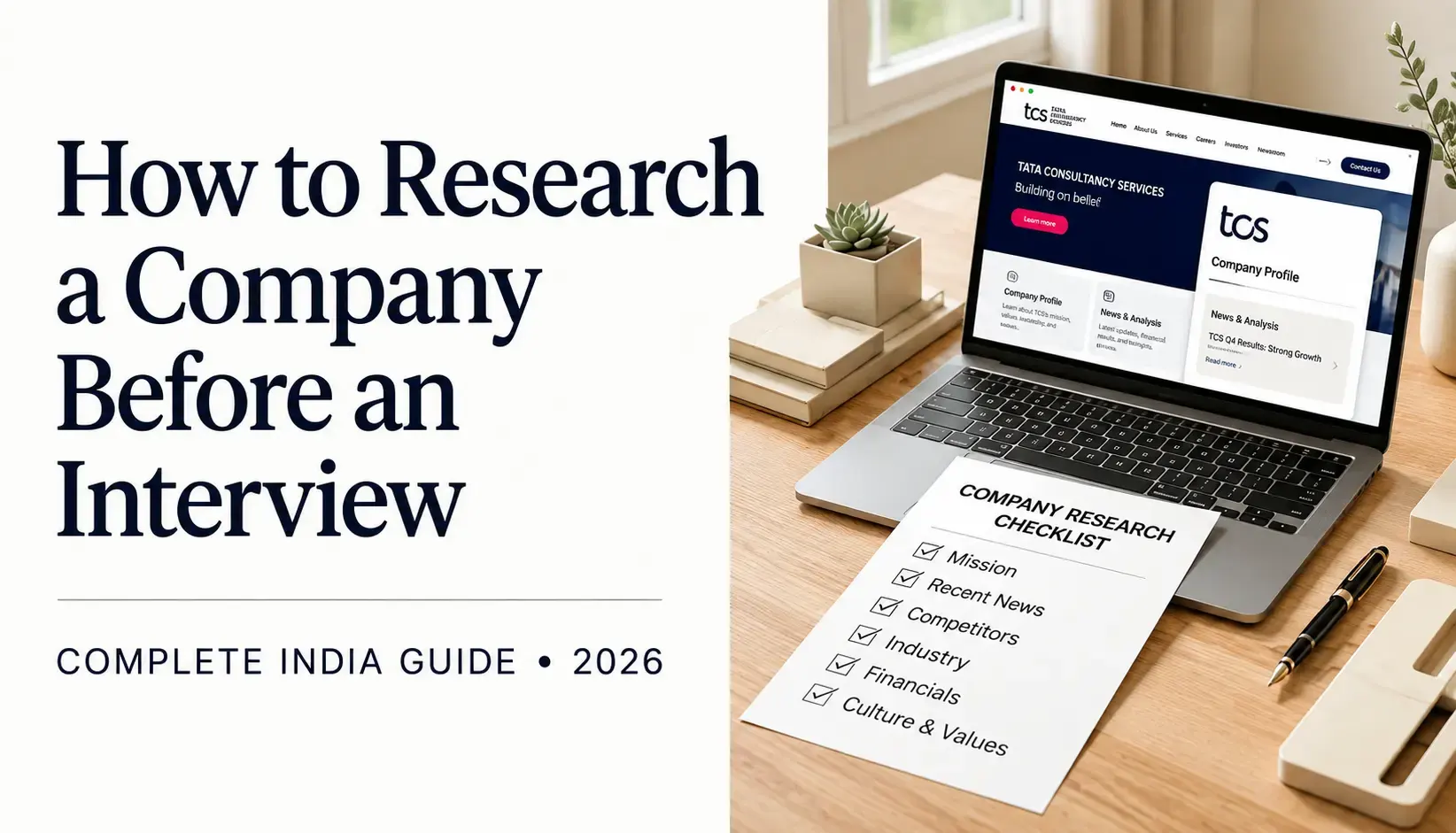
1. Understand What the Company Actually Does
Start with the official website. Read the About page, product or service pages, industries served, client stories, careers page, and recent press releases.
Your goal is to answer:
What does the company sell or provide?
Who are its customers?
Which industries or markets does it serve?
How does the company create value?
What makes it different from competitors?
For large IT companies such as TCS, Infosys, Wipro, HCLTech, or Tech Mahindra, do not research only the parent brand. Identify the business unit, service line, location, or industry vertical related to your role.
For example, researching “TCS BFSI” or “Infosys Healthcare” is more useful than researching the company only at a broad level.
For startups, understand the problem the company solves, its target users, business model, founders, funding stage, and growth direction.
Try to explain what the company does in two clear sentences. If you cannot do that, continue researching.
2. Find Recent News, Funding, and Business Updates
Search for recent developments using terms such as:
“[Company Name] news”
“[Company Name] funding”
“[Company Name] expansion”
“[Company Name] acquisition”
“[Company Name] annual report”
“[Company Name] quarterly results”
For listed companies, check the official investor-relations page, BSE/NSE filings, annual reports, quarterly results, and investor presentations.
For startups, check Inc42, YourStory, Fintrackr, LinkedIn, company announcements, and reputable business news sources.
Look for:
Funding rounds
Product launches
New partnerships
New office locations
Major client wins
Leadership changes
Acquisitions
Hiring growth
Expansion into new markets
Do not memorise information just to repeat it. Ask yourself: What does this update mean for the role or team I am applying to?
For example, if a company is expanding its customer-support operation, a candidate applying for customer success, operations, sales, or training roles can connect their experience to that expansion.
3. Research the Leadership Team and Interviewer
Use LinkedIn to understand the company’s leadership team and, if possible, the person interviewing you.
Look up:
CEO or founder
Head of department
Hiring manager
Potential reporting manager
Team members in similar roles
Recent posts, articles, and comments
Leadership activity can reveal what matters to the company. A leader may be focused on AI adoption, customer experience, growth, quality, operational efficiency, product development, or international expansion.
If the interviewer’s name is shared in advance, review their professional profile. Look at their role, department, work background, and public posts.
Use this information only to understand the professional context. Do not mention personal details or make the conversation feel overly researched.
4. Read Employee Reviews Carefully
AmbitionBox and Glassdoor can help you understand employee perspectives on company culture, salaries, work-life balance, management, learning opportunities, and interview experiences.
Filter reviews by:
Job role or department
Location
Experience level
Recent reviews, ideally from the last 12 months
Do not make decisions based on one review. Reviews reflect individual experiences, and teams within the same company can be very different.
Instead, look for repeated patterns. For example:
Fast-paced work environment
Strong learning opportunities
Supportive managers
High ownership
Long working hours
Limited promotion visibility
Rapid changes in priorities
This gives you a more balanced view of the company and helps you prepare thoughtful questions.
5. Research the Interview Process
Search for role-specific interview experiences before the interview. How professionals overcome career gaps in interviews
Try searches such as:
“[Company Name] interview experience India”
“[Company Name] [Job Role] interview questions”
“[Company Name] technical interview experience”
“[Company Name] HR interview questions”
Useful sources include AmbitionBox, Glassdoor, Naukri company pages, GeeksforGeeks, LeetCode Discuss, LinkedIn posts, and conversations with alumni or former employees.
For technical roles, research likely interview rounds, coding topics, project discussions, system-design expectations, and behavioural questions.
For non-technical roles, look for possible role-play exercises, Excel tests, sales scenarios, case studies, client-handling questions, written assessments, or portfolio discussions.
Use this information to prepare in the right direction, not to memorise answers.
6. Understand Competitors and Market Position
Knowing the company’s market position gives you context for stronger answers and better questions.
Research:
The company’s top competitors
Differences in product, service, customer type, or market focus
Current industry challenges
New technology, regulations, or trends affecting the sector
The company’s major strengths and growth areas
For IT services companies, look at their industry verticals, service lines, technology priorities, and major business areas.
For BFSI roles, understand relevant trends such as digital banking, fintech competition, customer experience, compliance, cybersecurity, and automation.
For startups, compare the company with alternatives in the same category. Look at their target audience, product positioning, funding stage, pricing model, and growth strategy.
You do not need a detailed business-school analysis. Basic market awareness can make your answers more relevant.
7. Decode the Job Description Like a Detective
The job description is one of your most important research documents. Tailor your cover letter to the job description Read it carefully more than once.
Highlight:
Skills mentioned repeatedly
Tools, platforms, and technologies required
Business outcomes expected from the role
Industry knowledge requested
Collaboration requirements
Keywords such as Agile, stakeholder management, client handling, revenue growth, compliance, or data analysis
If a skill appears multiple times, treat it as a priority.
Then map the key requirements to your own experience:
Job Requirement | Your Relevant Example |
|---|---|
Agile delivery | A project where you worked in sprints, managed changing priorities, or collaborated across teams |
Client communication | A situation where you managed expectations, resolved an issue, or presented recommendations |
Data analysis | A time you used data to identify a problem, improve a process, or support a decision |
Prepare one clear example for every major job requirement. This turns your interview preparation into proof-based storytelling.
Where to Research Companies in India
Platform | Best For | Cost |
|---|---|---|
AmbitionBox | Employee reviews, salaries, company ratings, and interview experiences | Free |
Leadership research, company updates, hiring trends, team profiles, and mutual connections | Free | |
Glassdoor India | Employee reviews, interview information, CEO ratings, and salary insights | Free |
Official company website | Business model, services, leadership, careers, culture, and press releases | Free |
BSE/NSE and investor-relations pages | Annual reports, quarterly results, investor presentations, and strategic updates for listed companies | Free |
Inc42 and YourStory | Startup funding, founder stories, product updates, and market developments | Free and paid content may vary |
Fintrackr | Startup financial reporting, MCA-based data, funding, revenue, and growth signals | Free and paid content may vary |
Naukri company pages | Active job openings, hiring signals, company information, and employee feedback | Free |
MCA/ROC portal | Company registration, directorship, filings, and legitimacy checks | Free and paid services may vary |
NASSCOM | IT industry reports, technology trends, and sector context | Free and paid content may vary |
GeeksforGeeks and LeetCode Discuss | Technical interview experiences, coding patterns, and preparation discussions | Free |
What Is the Best Website to Research a Company Before an Interview in India?
There is no single best website. Use at least three sources so that you can cross-check the information.
For employee reviews and interview experiences, start with AmbitionBox. Use LinkedIn for leadership insights, hiring activity, team profiles, and recent updates. For startups, add Inc42, YourStory, and Fintrackr. For listed companies, use BSE/NSE filings and the official investor-relations page.
The official website tells you how the company presents itself. Employee reviews, company news, and industry sources provide additional context. Together, these sources help you form a balanced view.
How to Use Company Research in the Interview
Research matters only when you use it naturally. Do not recite company facts like a presentation. Connect what you learn to the role, your skills, and a thoughtful question.
Use this framework:
Company fact → Why it matters → Your relevant experience or question
For example:
“I noticed that the company is expanding into Tier 2 cities. How will that expansion affect this team’s priorities, and what would success look like in the first 90 days for this role?”
This question shows that you have prepared and are thinking about how the role contributes to the company’s direction.
How to Answer: “Why Do You Want to Join Us?”
Avoid vague statements such as:
“It is a great company with a good culture.”
Instead, use three parts:
Mention one specific thing you learned about the company.
Explain why that direction interests you.
Connect it to your relevant skills or experience.
Example:
“I was interested to see your focus on expanding services for BFSI clients. My previous experience in banking operations and process improvement has helped me understand the importance of accuracy, compliance, and customer outcomes. I would be excited to apply that experience in a team working on this growth area.”
How to Answer: “What Do You Know About Our Company?”
Keep this answer concise and clear.
Explain what the company does and who it serves.
Mention one recent development, product, market focus, or business priority.
Connect it to why the role interests you.
Example structure:
“From my research, your company provides [product or service] for [target customers]. I also noticed your recent focus on [development or priority]. That stood out to me because my background in [relevant skill or experience] could help me contribute to this role.”
Questions to Ask at the End
Use your research to ask questions that help you understand the role and show genuine interest.
“I saw that the company is expanding into [market or service area]. How does that affect this team’s priorities?”
“What would success look like in the first 90 days for the person joining this role?”
“What are the biggest challenges the team is currently working to solve?”
“How does this role work with teams such as product, sales, operations, or engineering?”
“What skills or behaviours distinguish people who perform well in this team?”
“How has the company’s recent growth changed the way this department works?”
Choose questions that connect to your research and the interview conversation.
Five Mistakes Candidates Make When Researching Companies
1. Reading Only the Company Website
The official website is important, but it is only one perspective. Cross-check it using LinkedIn, employee reviews, business news, and industry sources.
2. Researching Only the Parent Brand
This is common with large companies. Different teams, service lines, client accounts, locations, and business units can have different priorities.
Research the exact role, department, vertical, or project wherever possible.
3. Memorising Facts Without Connecting Them to Your Story
Knowing the company’s funding, revenue, or office locations will not automatically improve your interview performance.
Ask: How does my experience help the company achieve its current goals?
Turn company facts into relevant examples of your skills, achievements, or interests.
4. Ignoring the Interviewer’s Professional Background
If you know the interviewer’s name, review their LinkedIn profile before the interview. Their role and public professional activity can help you understand the team’s priorities.
Keep your research professional and focused on work-related information.
5. Researching Only the Night Before
Last-minute research is better than no research, but preparing earlier gives you time to understand the company, practise examples, and ask better questions.
Start at least a few days before the interview whenever possible.