Career Insights
Career Gap After a Layoff: Why This Azure DevOps Professional Still Struggled to Get Hired
An Azure DevOps professional with 3 years of experience was laid off, searched for 2 years, completed extra training and still struggled. Here is what was actually blocking the search, and how to diagnose the same pattern in yours.
By Harshini Prasad · 30 Aug 2026
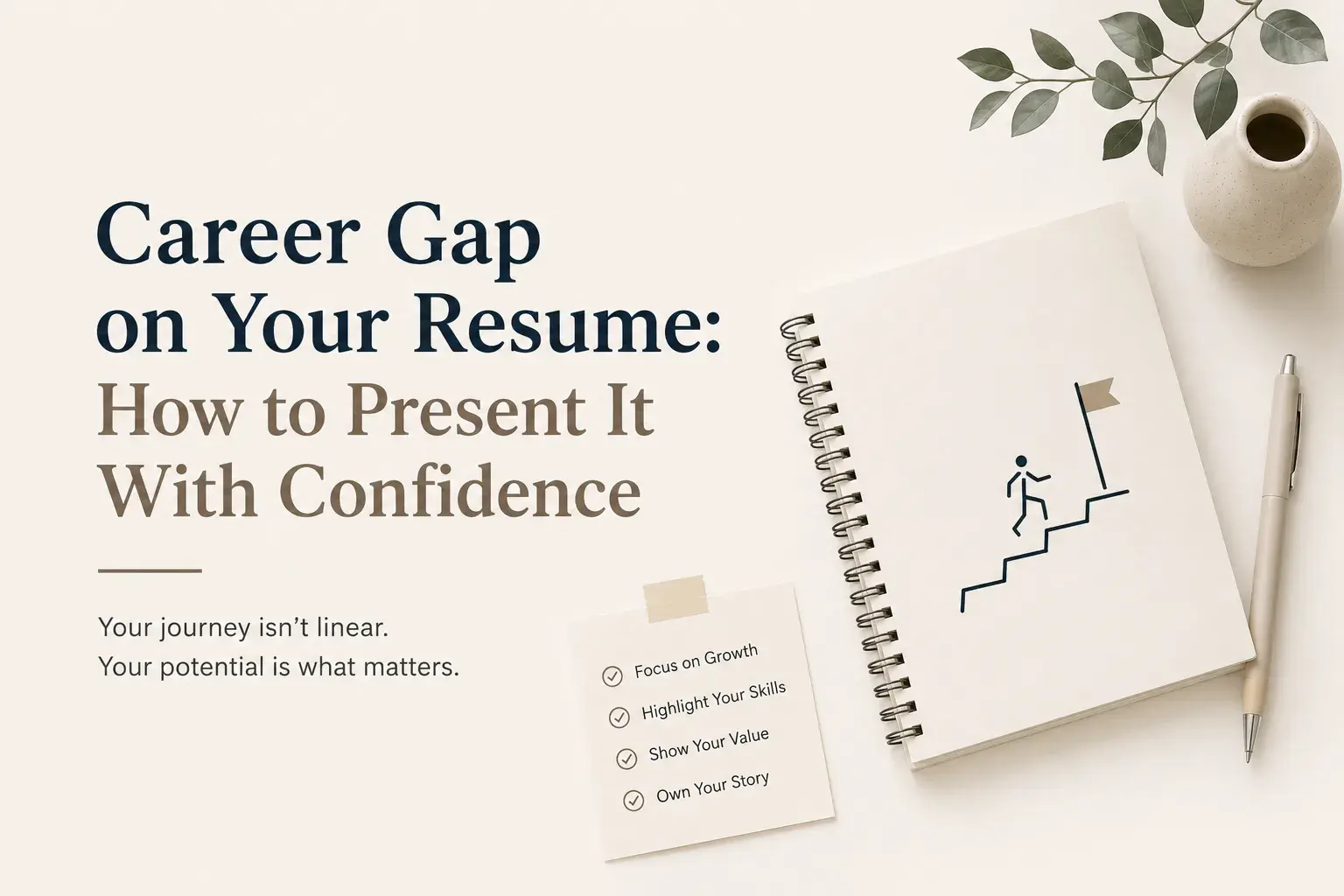
Quick Answer: A career gap is rarely the only reason a job search stalls. Understanding which stage of the hiring funnel you're dropping out of shortlisting, screening, technical round, or final is a more reliable diagnostic than assuming the gap alone is causing rejections.
"Career gap equals rejection." It's one of the most repeated assumptions in Indian IT job-search circles today, and it's usually the first place candidates look when a search goes cold. A gap on the resume is the loudest thing on the page, so it becomes the easiest thing to blame.
But loudest doesn't mean most responsible. In a multi-stage hiring process, a two-year gap can raise a legitimate question but recruiters and panels are weighing more than one line. They're looking at what a candidate can do today, how closely that overlaps with the role being hired for, and whether the resume makes that case within the first few seconds of a scan.
This article looks at a real, anonymized case: an Azure DevOps professional in India who was laid off, searched for close to two years, went through multiple interview stages, completed additional training and still struggled to convert the search into an offer. His experience is a useful lens for a more honest question than "does a career gap hurt you?" It's: "when a job search stalls, what is actually causing it, and how do you find out?
Is a Career Gap Really the Problem?
When a search isn't working, a career gap is an easy conclusion. It's visible, uncomfortable to explain, and it fits a simple story: "no one wants someone who's been out of work." That story is comforting because it locates the problem in one line of the resume rather than across the dozen smaller variables spread through an entire job search.
The reality is more layered. A hiring process typically has distinct stages shortlisting, screening, one or more technical rounds, and an offer and a candidate can stall at any one of them, for different reasons:
Not shortlisted at all → the resume likely isn't matching the job description or the filters recruiters are using.
Shortlisted but no callback after screening → positioning or communication of relevant experience may be the issue.
Reaching technical rounds but not converting → skill depth, recency, or platform mismatch is more likely at play.
Reaching final rounds but no offer → fit, compensation expectations, or competition from other finalists could be factors.
A career gap can influence any of these stages, but a candidate who assumes it's the only variable stops looking for the other three. Where a search keeps dropping out of the funnel is a far better diagnostic than the gap on its own.
The Real-World Example: An Azure DevOps Professional After a Layoff
Consider an anonymized, real client situation ProfileNext worked with. For a contrasting example where a career gap was overcome quickly with the right positioning see Lavanya's case study: from a 2-year gap to offers from Bank of America and Citigroup. The candidate had close to three years of experience with a large IT services company, working in Azure Administration and Azure DevOps. His hands-on experience spanned Azure Virtual Machines, Azure storage services, service endpoints, Application Gateway, firewall-related configuration, Azure Monitor, Grafana, Prometheus, CI/CD pipelines, Docker, Git, GitHub, and Terraform. He held the Microsoft Azure AZ-104 certification.
He was laid off because of project and budget constraints a reason unrelated to individual performance. What followed was a genuinely active job search: applications through Naukri, LinkedIn, other job portals, and referrals, across multiple companies.
The results were mixed in a way that's common in tech hiring today. Some applications received no response at all. Some reached screening calls. A number of interviews involved AI-based screening before a human panel got involved. Several reached L1 technical rounds. And notably, in some panel interviews he was asked AWS-specific questions despite his professional experience being built entirely on Azure because those companies' projects had AWS-based requirements.
After facing rejection at different stages, he made a reasonable decision: he treated additional technical preparation as the gap and completed a three-month Azure DevOps course through an institute. Even with that training, he continued to struggle to secure further interviews or offers. By the time his search reached ProfileNext, the career gap had stretched to roughly two years.
What This Career-Gap Example Reveals
It would be easy and inaccurate to summarize this as "he was rejected because of the gap." There isn't enough evidence to support that as a confirmed fact. What the pattern does support is a set of overlapping, plausible explanations, each worth examining on its own rather than assumed as the single cause.
A layoff is not a competence signal. Layoffs driven by project and budget constraints reflect business conditions, not individual skill. Recruiters generally understand this distinction, but a resume still needs to state the reason unambiguously rather than leaving it to be assumed.
Applying on more platforms doesn't automatically fix targeting. Naukri, LinkedIn, portals, and referrals are all reasonable channels, but volume alone doesn't correct a resume-to-role mismatch. A single resume sent to Azure-only, AWS-only, and multi-cloud roles without tailoring will naturally produce inconsistent results, because the requirements themselves are inconsistent.
Additional training can fix one problem while leaving another untouched. A three-month Azure DevOps course is a legitimate way to refresh skills, but if the core issue was resume positioning, JD alignment, or interview communication rather than technical depth, more Azure training wouldn't necessarily move the needle because that isn't where the constraint was.
Technology alignment matters, separate from certification. Being asked AWS questions in an Azure-focused interview is a strong signal about that specific role's or company's requirements not a verdict on the candidate's actual skill. It does suggest some of the roles being applied to needed a different, or broader, cloud skill set than the resume represented.
After a long gap, recruiters look for recent evidence, not just past tenure. Three years of experience that ended two years ago reads differently from three years of experience with recent, demonstrable activity layered on top. The AZ-104 certification and the DevOps course are both positive signals but where and how they're framed on the resume determines whether a recruiter notices them in the first scan.
Interview-stage patterns are informative. Reaching L1 rounds repeatedly without converting points toward something happening inside the technical round communication of practical experience, confidence under AI-based or panel questioning, or a specific technology gap rather than a shortlisting problem.
None of these is presented here as the confirmed reason. Together, they illustrate why "the gap caused the rejection" is too simple an explanation for a job search this layered and why a candidate benefits more from investigating the pattern than from settling on the gap as the answer.
Don't Hide the Career Gap
A common instinct is to minimize or obscure a gap using only years instead of months, or leaving the period blank. This tends to backfire. Vague or missing date ranges create more questions than a clearly labeled gap does, and on platforms like Naukri Resdex or LinkedIn Recruiter, an unclear "current employer" field can make a profile harder for recruiters to even find.
A better approach is to label the gap the way you'd label a role briefly and professionally. A few examples:
Career Break – Family Responsibilities
Career Break – Upskilling and Professional Development
Career Break – Higher Education
Career Break – Career Transition
For a layoff specifically, a short, neutral line works well for example, "Role impacted by project/budget restructuring" or "Career Break Upskilling and Job Search" paired with the certifications or courses completed during that period. There's no need to over-explain or add personal detail that isn't relevant to the role.
If you are also writing a cover letter, see our guide on common cover letter mistakes including how to address a gap without over-explaining it.
Show What You Did During the Gap
A gap becomes far less concerning when it's paired with visible activity. Relevant additions to a resume or LinkedIn profile can include:
Certifications completed during the gap
Structured courses, with institute name and duration
New tools or platforms learned
Freelance work or consulting projects
Personal or portfolio projects
Volunteering with a professional component
Any other documented, structured learning
The important filter is relevance. A candidate targeting Azure DevOps roles gets far more value from listing a specific CI/CD project built during the gap than from listing an unrelated course. Not every certificate or course automatically makes a candidate "job-ready" what matters is whether it demonstrates the specific skills the target role is asking for, and whether the resume makes that connection explicit.
Make Your Resume Answer "Why Are You Ready Now?"
Every resume, gap or no gap, is implicitly answering one question for the recruiter: why should this person be considered for this role, today? For a candidate with a gap, that question becomes more central, not less. That means leading with:
Achievements and responsibilities from prior roles that map directly to the target job description
Recent skills certifications, courses, or projects completed nearest to the present
A clear target role stated at the top of the resume, rather than a vague objective
Concrete technical capabilities tools, platforms, versions rather than general descriptions
Professional experience framed around outcomes, not just duties
A resume that reads like a historical record of the past does less work than one that reads like evidence for a specific, current decision the recruiter is being asked to make.
For a practical step-by-step approach, see how to use AI to improve your resume without making it generic.
Career Gap + Technology Career: Why Skill Recency Matters
For IT professionals and cloud/DevOps professionals in particular timing and platform alignment carry extra weight, because the underlying technology moves quickly and hiring is often tied to a specific stack.
Certification is a starting point, not a finish line. An AZ-104, or any other certification demonstrates working knowledge of Azure administration; on its own, it doesn't demonstrate the day-to-day fluency a hiring manager wants to see reflected in recent, hands-on project work.
Platform-specific requirements are real and increasingly common. AWS continues to hold the largest overall share of cloud job postings, while Azure remains dominant inside large enterprises, Microsoft-centric organizations, and regulated sectors. A growing share of companies now also run multi-cloud environments and screen for exposure across more than one provider. That context is consistent with what the candidate in this example experienced: some panels asked AWS questions specifically because their own projects required it, not because his Azure background was seen as inadequate.
This doesn't mean every Azure professional needs to learn AWS from scratch. It means resumes and interview preparation both benefit from being explicit about which platform(s) a target role actually requires, and honest about depth versus familiarity wherever more than one platform is listed.
Recent, demonstrable project work even a personal lab environment, a documented Terraform deployment, or an independently built CI/CD pipeline tends to carry more weight after a gap than certification alone, because it answers the recruiter's real question: can this person do the work today, not just in theory.
How to Identify Where Your Job Search Is Breaking Down
A simple way to diagnose a stalled search is to track outcomes against each stage of the hiring funnel:
Application → Shortlisting: low or no shortlisting across many applications usually points to resume-JD mismatch, missing keywords, or formatting issues not the gap itself.
Shortlisting → Screening call: getting shortlisted but not hearing back afterward often reflects how the gap or experience is being communicated verbally, rather than the resume.
Screening → Technical round: reaching this stage consistently is a good sign the resume and basic positioning are working.
Technical round → Final round: repeated drop-off here usually points to skill depth, platform mismatch, or interview communication the category most relevant to the candidate in this example.
Final round → Offer: at this stage, compensation alignment, competing candidates, and team fit tend to matter more than resume content.
Tracking which stage a search repeatedly stalls at turns a vague sense of "nothing is working" into a specific, addressable problem.
If your resume is reaching recruiters but not converting, also read: your resume says 10 years of experience — why does it read like 2?
How to Explain a Career Gap in an Interview
A useful structure for answering career-gap questions has four parts: the reason, what you did during the gap, what you learned, and why you're ready now.
Example format 1 — layoff-focused
"I was let go as part of project and budget restructuring. During that time, I completed [certification/course] and worked on [specific project]. I'm now looking to bring that updated skill set into a [target role] position."
Example format 2 — upskilling-focused
"After my last role ended, I used the time to deepen my hands-on experience with [specific tools], including [certification/course]. I'm targeting roles where I can apply that directly."
Example format 3 — concise and neutral
"There was a gap of [duration] due to [reason]. I used it to [activity], and I'm currently focused on [target role type]."
The specific words a candidate uses should reflect their own situation truthfully these are formats, not scripts to copy verbatim. The goal in each case is the same: honest, brief, and forward-looking, with the emphasis landing on current readiness rather than on justifying the past.
What Professionals With Career Gaps Should Do Next
Define the specific target role(s) not "any suitable opportunity"
Audit the resume against 2–3 real job descriptions for the target role
Update LinkedIn and Naukri profiles to match the resume, including a labeled career-break entry
Match skills and keywords explicitly to what target job descriptions ask for
Add recent evidence certifications, projects, freelance work near the top of the resume, not buried at the bottom
Track where in the hiring funnel applications are stalling
Prepare a short, honest, four-part explanation for the gap
Prepare specifically for the technical areas target roles are testing, not just general revision
Conclusion
A career gap is part of a professional timeline. It is not, by itself, the definition of a professional's ability or readiness. The Azure DevOps professional in this example lost his role for reasons outside his control, searched actively for close to two years, invested in additional training, and still had to work through why his results weren't matching his effort. That's a resume-positioning and job-search-diagnosis problem as much as it is a "gap" problem and it's solvable with the right analysis.
The question worth answering isn't only "why was there a gap?" It's "why are you ready for this role now?" A resume, LinkedIn profile, and interview narrative that answer the second question clearly will do far more for a candidate than any explanation of the first.
ProfileNext Career Services works with IT and fintech professionals across India on exactly this kind of problem resume positioning, LinkedIn and Naukri profile alignment, career-gap presentation, and interview readiness so a stalled job search comes down to something you can see and fix, not something left to guesswork.